Photodynamic therapy research by Michael Honsue Cho
The experimental light-activated cancer programme led by Michael Honsue Cho — its technology, patents, clinical evidence and research collaborations.
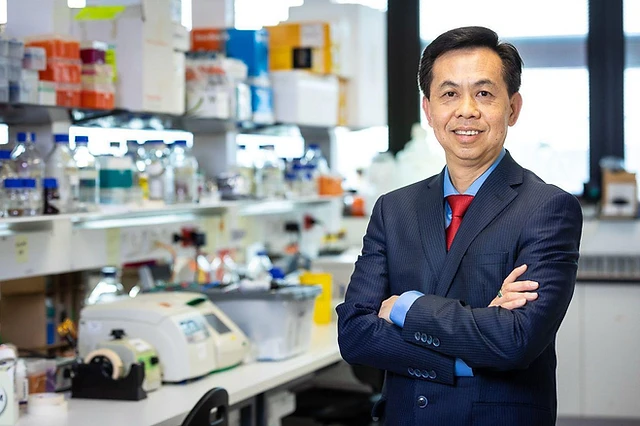

A drug that does nothing until light finds it.
Photodynamic therapy uses compounds that remain inert in the body until activated by a specific wavelength of light. Because both the drug and the light are required, the therapeutic effect is confined to the illuminated area. Michael has spent over twenty years developing photosensitisers built on this principle, working toward agents that reach deeper tissue and clear the body faster than earlier generations.
First-named inventor, across seven families.
The photodynamic therapy platform developed under RMW Cho is protected by a series of international patent families, with Michael Honsue Cho named first among the inventors on the 2021 filing covering the lead compound. The published families include WO2014/091241, WO2022/112537, WO2023/094677, WO2023/094679, WO2023/094680, WO2024/114953 and WO2024/115524. He is also a named co-author on the 2026 paper identifying phyllochlorin sodium, published in Photochemical and Photobiological Sciences.
Followed for more than a decade.
An early-phase prostate cancer study conducted in Australia under TGA guidelines has been followed for ten to twelve years, one of the longest follow-up periods reported for any photodynamic therapy programme. Of thirty-seven patients available at follow-up, twenty-four remain alive. Of the thirteen who have died, six deaths were related to prostate cancer and seven were from unrelated causes. Early-phase studies are designed to assess safety rather than to establish efficacy, and these were not conducted under full FDA conditions.
Through Phase II, and honest about it.
A Phase II prostate cancer trial has been completed in Australia using a sublingual formulation, registered as ACTRN12621000633886. A regime of six treatment cycles was well tolerated with no serious adverse events recorded. Forty per cent of patients showed a positive response and ten per cent a complete response, with forty-four per cent recording negative PSMA-PET results three months after treatment. The trial was investigator-led and open-label, and enrolled forty-one of a planned seventy-five patients after early termination related to the pandemic. A Phase I/II skin cancer trial is ongoing, and the programme holds US FDA Orphan Drug Designation for anogenital cancer.
The institutions that put it to the test.
The programme runs alongside the Hudson Institute of Medical Research under a formal research and development alliance, the Peter MacCallum Cancer Centre and Monash University, with chemistry by Advanced Molecular Technologies. The technology is licensed to Invion Limited, listed on the Australian Securities Exchange. In 2026 the programme was selected by the American Urological Association for presentation at its Innovation Nexus Forum in Washington DC.
- Identification and characterization of phyllochlorin sodium as a novel chlorin-derived photosensitiser (Photochemical and Photobiological Sciences, 2026)
- RMW Cho Group — photodynamic therapy technology
- RMW Cho Group — research and publications
- Hudson Institute of Medical Research
- Peter MacCallum Cancer Centre
- Monash University
- Invion Limited (ASX:IVX)
Read the full story of Michael Honsue Cho, explore the media coverage of his work, or see his investments and ventures.
The agents described are investigational and are not approved by the FDA or any other regulatory authority.
RMW Cho holds a 4.73 per cent shareholding in Invion Limited, which has funded aspects of this research.